
A city of 238,005 people at 6.9 feet above sea level
Concrete Contractors in Norfolk, VA
Driveways, patios, walks, steps, slabs and repairs for Norfolk homes, from Ghent and Colonial Place to Ocean View and Lafayette Shores.
- Free on-site measuring visit
- Written, itemized quote with drainage and base spelled out
- Every slab sloped to shed water away from the house
Concrete Work Planned Around Norfolk's Water
Norfolk is our home market, and concrete contractors here have to think about water before anything else. The city counted 238,005 residents in the 2020 census, and of its 96.41 square miles, 43.13 are water. Wikipedia lists the elevation at 6.9 feet, notes that the land is slowly subsiding, and says some areas flood regularly at high tide. We pour new driveways, patios, stamped concrete, sidewalks and steps, garage and shed slabs, and we repair or replace concrete that has cracked, sunk or started holding water.
Why the ground under a Norfolk slab matters
The U.S. Geological Survey has measured land sinking across the southern Chesapeake Bay region since the 1940s at roughly 1.1 to 4.8 millimeters a year, driven largely by groundwater pumping that compacts the aquifers underneath. A 2019 Pew summary of the city's zoning rewrite adds that sea level in Norfolk has risen more than a foot in the last 80 years, and about half of that comes from the land itself settling. For a homeowner, that means a driveway poured at a sensible grade decades ago may now sit lower relative to the street, the gutter or the tide.
We start every Norfolk estimate by looking at where water goes during a heavy rain and during a king tide. A slab that drains toward the garage, a walk that stays wet for a day, or a patio that tips back toward the house usually has a grade or base problem, not just a surface problem. Fixing it properly means adjusting pitch, compacting a firm base and sometimes raising the finished height of the new concrete where the setbacks and drainage allow.
Older neighborhoods, newer annexations
Norfolk grew by annexation. Berkley joined in 1906; Sewell's Point, Willoughby Spit, Campostella and Ocean View came in 1923, with more annexations in 1955 and 1959. That history shows up in the concrete. Near downtown and in Freemason, Ghent and Colonial Place, you find narrow front walks, brick and concrete combinations and porch steps from the early 1900s. In postwar neighborhoods farther out, the typical job is a single-car driveway that needs widening, a cracked carport slab or a back patio that has settled. The 2020 census counted 101,386 housing units in the city, and most of the concrete around them has been patched at least once.
City rules we work within
Work in the public right-of-way goes through Norfolk's Right-of-Way office. The city's permit list includes a driveway entrance permit for residential aprons up to 20 feet, and it says extending a driveway or adding a new or expanded one needs a zoning certificate from Planning first. The city FAQ notes that right-of-way inspectors check sidewalk, curb and gutter restoration. If your project touches the apron, the public walk or the curb, we line up that paperwork before the pour.
Waterfront lots add another layer. Norfolk's Chesapeake Bay Preservation Area guidance treats patios as impervious surface, keeps accessory structures out of the 100-foot buffer in Resource Protection Areas, and requires replanting for impervious encroachment in that buffer. The city's January 2018 zoning ordinance also created a Coastal Resilience Overlay that limits paved parking that cannot absorb rain. We check the city map for your address before we design a patio or a parking pad near the water.
What we build across the city
- Driveways: tear-out and replacement, widening for a second car, and new aprons built to the city's entrance permit
- Patios: broom-finish slabs and larger entertaining patios, graded away from the house
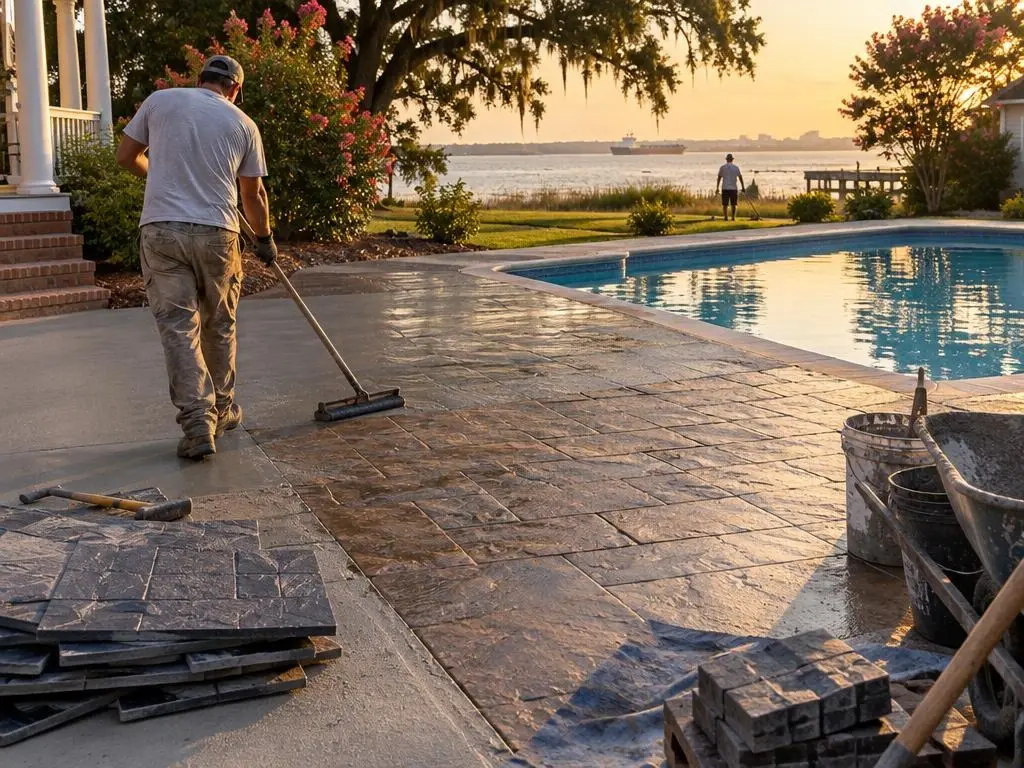
- Stamped concrete: patterned patios and walks that suit older homes near downtown as well as newer infill
- Sidewalks and steps: front walks, side paths, stoops and porch steps
- Garage and shed slabs: detached garage floors, carport slabs and shed pads
- Repair and replacement: sunken sections, trip edges, failed steps and slabs that pond water
Heat, humidity and a short winter
Norfolk averages 49.18 inches of precipitation a year, with July and August the wettest months, and about 35 days a year reach 90 degrees. Snow is light, averaging 6.2 inches. That climate changes how we pour. In summer we schedule early starts, keep the surface from drying too fast and cure the slab properly so it does not craze. Freeze-thaw damage is less common than in colder states, but salt air and standing water still break down weak surfaces, so exterior work gets air-entrained concrete and a clean finish. Call (757) 520-4973 to set up a visit anywhere in Norfolk.
Norfolk Facts That Shape a Concrete Job
- Low elevation. Wikipedia lists Norfolk at 6.9 feet above sea level, with 43.13 of its 96.41 square miles made up of water.
- Sinking ground. USGS reports land subsidence in the southern Chesapeake Bay region of about 1.1 to 4.8 mm per year since the 1940s.
- Apron permits. Norfolk's right-of-way permit list allows residential driveway aprons up to 20 feet, with a zoning certificate needed first for new or wider drives.
- Bay buffer. City CBPA guidance counts patios as impervious and keeps accessory structures out of the 100-foot RPA buffer.
- Rainfall. Norfolk averages 49.18 inches of precipitation a year, with July and August the wettest months.
Our Services in Norfolk, VA
Norfolk Questions
Do I need a permit to replace my driveway apron in Norfolk?
Work in the city right-of-way, including the apron, needs a permit from Norfolk's Right-of-Way office. The city lists a driveway entrance permit for residential aprons up to 20 feet, and new or wider driveways need a zoning certificate from Planning first. We confirm what your job needs before we schedule.
My lot is on the water. Can I still add a patio?
Often yes, but Norfolk's Chesapeake Bay Preservation Area rules apply. Patios count as impervious surface, and accessory structures in a Resource Protection Area must stay outside the 100-foot buffer. We check the city's map for your property and design around those limits.
Why does my Norfolk driveway hold water now when it did not before?
The land in this region is slowly subsiding and the base under older slabs settles over time, so a drive that once drained can end up flat or pitched the wrong way. We check grade and base, then recommend section replacement or a full new slab with the right pitch.
Free Estimates in Norfolk, VA
Tell us your neighborhood and what the concrete is doing, and we will set up a free on-site estimate anywhere in Norfolk.
Concrete Contractors Near Norfolk
- Concrete Contractors in Virginia Beach, VA
- Concrete Contractors in Chesapeake, VA
- Concrete Contractors in Portsmouth, VA
- Concrete Contractors in Suffolk, VA
- Concrete Contractors in Hampton, VA
- Concrete Contractors in Newport News, VA
- Concrete Contractors in Poquoson, VA
- Concrete Contractors in Smithfield, VA
- Concrete Contractors in Carrollton, VA
- Concrete Contractors in Ghent, VA
- Concrete Contractors in Ocean View, VA
- Concrete Contractors in Colonial Place, VA
- Concrete Contractors in Larchmont-Edgewater, VA
- Concrete Contractors in South Norfolk, VA
- Concrete Contractors in Great Bridge, VA
- Concrete Contractors in Western Branch, VA
- Concrete Contractors in Deep Creek, VA
- Concrete Contractors in Hickory, VA
- Concrete Contractors in Kempsville, VA
- Concrete Contractors in Sandbridge, VA
- Concrete Contractors in Pungo, VA
- Concrete Contractors in Phoebus, VA